


On Elaheh Motamedi Moghaddam’s Recent Exhibition at Art Wall (Risheh Collection)
Encounter
The art wall exhibition “Encounter” by Elahe Motamedi Moghaddam, born in 1987 and holding a Bachelor’s degree in Chemistry, has been held at Gallery Risheh 29 from January 2 to January 16, 2025 and has welcomed audiences throughout this period. The exhibition began during a time of social unrest in Tehran, and this temporal coincidence has imbued it with a meaning beyond a purely artistic event. Its continuation under such circumstances represents a quiet, understated act of resistance—one that emphasizes “perseverance” rather than protest.
Elahe Motamedi Moghaddam, originally from Isfahan, has built her artistic practice on lived experience, studies in Jungian analytical psychology, and spiritual inquiry. This combination of scientific perspective (stemming from her background in chemistry) and inner exploration is reflected in the forms of her work, which do not merely narrate visually but represent the psychological states of contemporary humans.
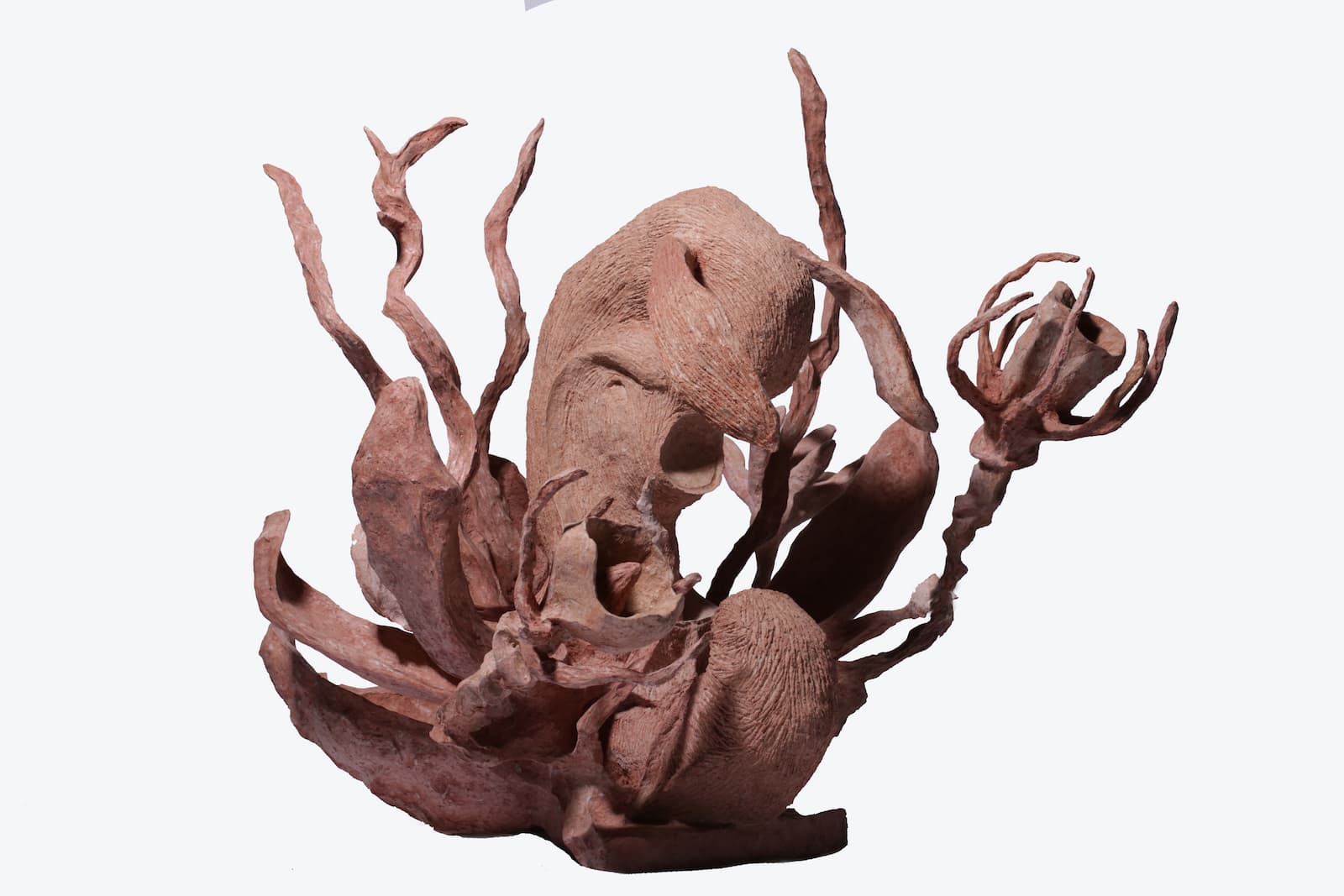
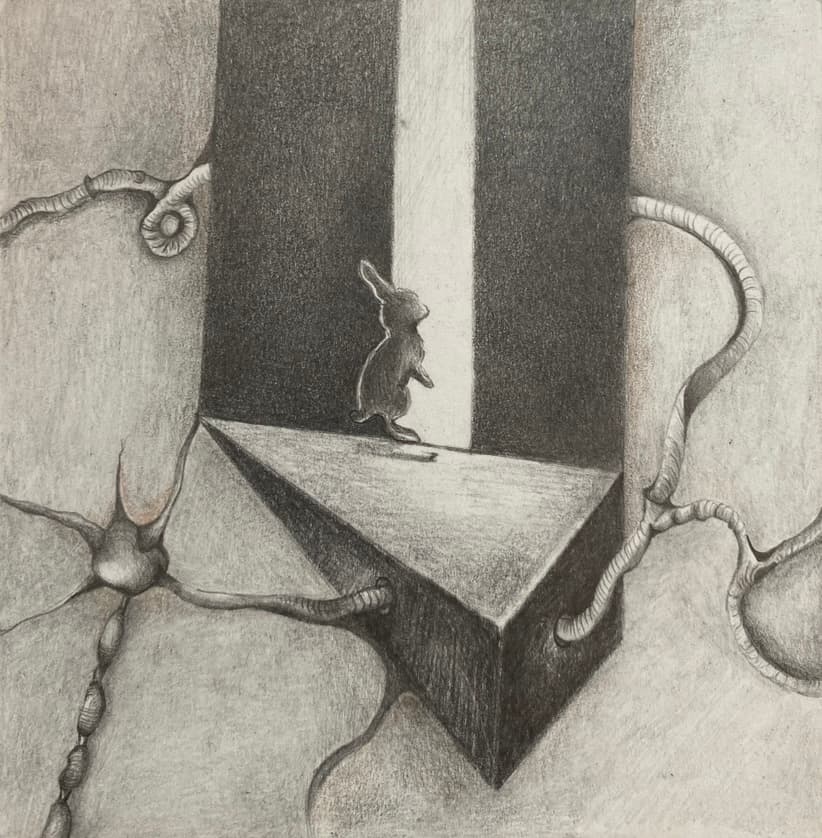
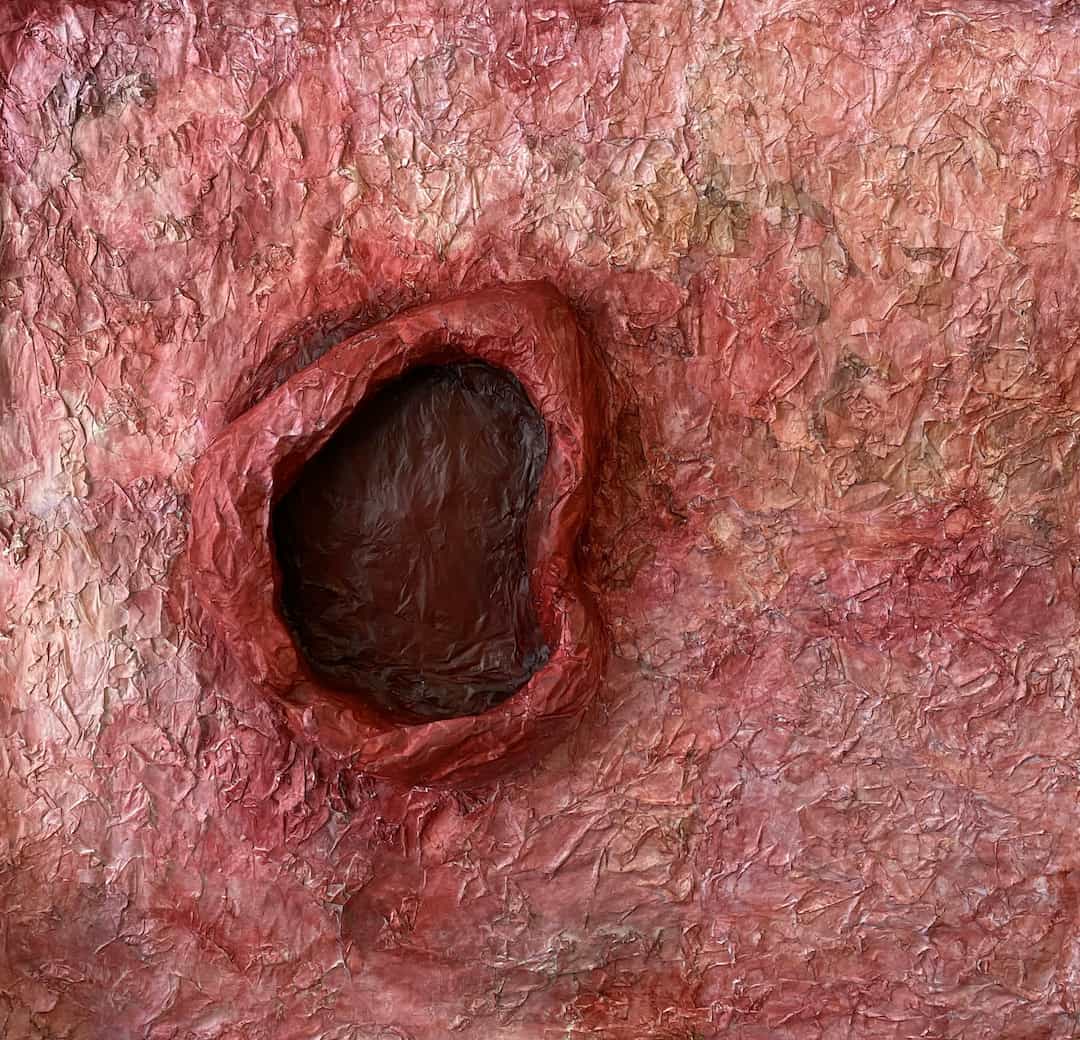
The current exhibition includes small-scale drawings, paintings, and sculptures in papier-mâché. The choice of this medium carries meaning: papier-mâché is simultaneously fragile and reconstructible, much like individuals and communities in times of crisis. The small drawings resemble personal notes—moments of self-confrontation—while the sculptures, with their semi-human and animal-like forms, depict a state of suspension between instinct and awareness, where Jungian unconscious themes intersect with contemporary experience.
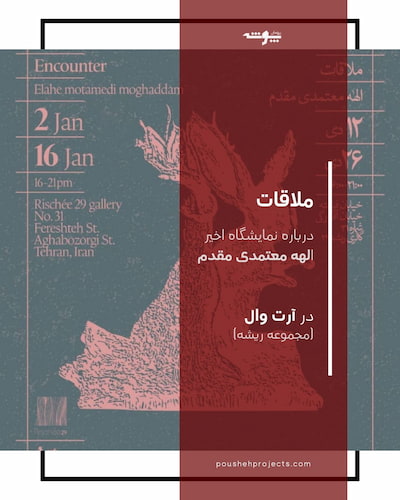
The exhibition poster itself functions as an independent visual text. The central image depicts a leaping, dual-natured figure, suspended between earth and air—not entirely falling, nor fully flying. This figure serves as a metaphor for the contemporary human condition: suspended between anxiety and liberation. The soft pink tones over a cold, gray background create a contrast between delicacy and harshness, vulnerability and resilience. The rough texture of the image echoes the tactile quality of the papier-mâché works, reinforcing the exhibition’s world as fragile yet enduring.
The arrangement of information on the poster in both Persian and English, symmetrically placed on either side of the image, introduces a sense of visual order against the formal chaos, as if reason and structure are counterbalancing the figure’s instinctive movement. In this way, the concept of “Encounter” is not only about the audience engaging with the artwork, but also about the interaction between two psychological states.
Meanwhile, the role of Hoda Sargordan as the director of Gallery Risheh goes beyond administration; it is a cultural act. Maintaining the exhibition at a time when many cultural spaces are closed or inactive represents a form of resistance—resistance that preserves the possibility of dialogue through art.
“Encounter” can be seen as an exercise in hope—not naive optimism, but the determination to continue. This exhibition demonstrates that art can serve as a temporary refuge amid turmoil: a space for pause, confrontation, and inner reconstruction. Ultimately, “Encounter” captures a moment of conscious wandering—a wandering that, while painful, is still visualized, created, and brought to the wall.
Ghazaal Zare
Winter 2025–2026

No comment